
Choosing the right Solar Panel Off Grid System can be overwhelming. With numerous options available, how do you decide? Renowned solar energy expert Dr. Emily Sun says, "The best off-grid system combines efficiency and reliability." Her insight underscores the importance of understanding your unique energy needs.
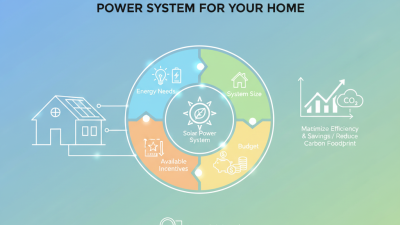
The Solar Panel Off Grid System not only offers independence from the grid but also requires careful consideration. Factors like energy consumption, installation costs, and geographic location play crucial roles. It’s essential to evaluate your lifestyle demands and budget constraints. Often, individuals overlook the significance of proper sizing and configuration, leading to suboptimal performance.
Exploring diverse systems can reveal unexpected challenges. Many users find themselves with insufficient power, while others may invest too heavily in unnecessary features. Reflecting on personal energy needs can lead to more informed choices. Ultimately, a well-planned Solar Panel Off Grid System can enhance your energy autonomy and reduce long-term costs.
Assessing your energy needs is crucial for selecting the right off-grid solar panel system. Start by calculating your daily energy consumption. For instance, the average U.S. household uses about 30 kWh per day. If your needs differ, you can easily adjust your calculations. Use a simple method: list all electrical appliances and their wattage.
Next, determine how many hours each appliance will be used daily. Multiply the wattage by the hours of usage to find the total watt-hours for each device. Then, add up these totals to get your daily energy requirement. This approach allows for a customized energy plan tailored to your actual usage.
Consider unexpected factors, such as seasonal changes and appliances' efficiency. Reports indicate that some solar panel systems lose efficiency in colder temperatures. Additionally, account for potential increases in energy use during certain months. Engaging with local solar energy experts can provide reliable insight. They can guide you through any complex calculations or challenges you face. It's important to adapt your plans as your energy needs evolve over time.
When considering an off-grid solar panel system, it’s essential to understand the different types of solar panels available. Two main types dominate the market: monocrystalline and polycrystalline panels. Monocrystalline panels are known for their high efficiency and space-saving design. They work well in limited areas, providing more energy per square meter. However, they come with a higher price tag.
Polycrystalline panels are more cost-effective but tend to be less efficient. These panels are made from multiple silicon crystals. They require more space to produce the same amount of energy. This can be a crucial factor if you have limited roof or ground space.
Another option is thin-film solar panels. They offer flexibility and are lightweight. However, they generally have lower efficiency and may require more installation area. Evaluating your energy needs and available space is vital. Without careful consideration, you may end up with a system that does not meet your requirements. Finding the right balance between cost and efficiency is key. Be prepared to adjust your expectations based on the specifics of your location and the resources you have.
When evaluating off-grid systems, focus on inverters and charge controllers. These components are crucial for system efficiency and functionality. Inverters convert DC power into AC, allowing you to use standard appliances. Charge controllers manage the power flow from solar panels to batteries, preventing overcharging and extending battery life.
A good inverter should have a high efficiency rating, ideally above 90%. According to the National Renewable Energy Laboratory, high-quality inverters operate optimally, reducing energy losses. Look for models that offer both pure sine wave output and basic protection features to safeguard against surges and overloads.
When selecting a charge controller, consider its type. Maximum Power Point Tracking (MPPT) controllers can improve energy harvest by up to 30% compared to Pulse Width Modulation (PWM) controllers. However, MPPT controllers are typically more expensive. Tip: Evaluate your energy needs and calculate the extra energy potential against your budget. Don't rush the decision—choose based on long-term performance, not just initial costs.
| Feature | Importance | Considerations | Typical Ratings |
|---|---|---|---|
| Solar Panel Efficiency | High | Choose panels with 15% - 22% efficiency for better performance. | 15-22% |
| Battery Storage Capacity | High | Select batteries based on daily energy consumption. | 100Ah - 400Ah |
| Inverter Type | Medium | Consider pure sine wave inverters for sensitive electronics. | 1000W - 5000W |
| Charge Controller | High | MPPT controllers are preferred for better efficiency. | 10A - 100A |
| System Size | High | Calculate total wattage needed for all appliances. | 1kW - 10kW |
| Warranty Period | Medium | Look for at least 10 years warranty on panels. | 10-25 years |
Determining the appropriate battery storage for an off-grid solar system is essential. First, you need to calculate your daily energy consumption. For example, if you use 30 kWh daily, you'll require a battery system that can store enough energy to cover several days without sunlight. Experts recommend planning for at least three days of backup power. This means you would need a minimum of 90 kWh of battery capacity.
When considering battery type, lithium-ion batteries provide high efficiency and longer lifespans, averaging about 15 years. In contrast, lead-acid batteries are less expensive but typically last only 5-7 years. The depth of discharge is another critical factor. Lithium batteries can often be discharged to 80% while lead-acid should only be discharged to 50% to maintain longevity.
You must also consider the inverter's capability. It should match your peak load requirements. For instance, if your appliances require 5 kW during peak usage, ensure the inverter can handle this without overheating. Regular monitoring of battery health is vital; failing to do so may lead to underperformance and unexpected expenses. Balancing these factors ensures you create an efficient and effective off-grid solar system tailored to your needs.
When considering an off-grid solar system, understanding costs and return on investment (ROI) is crucial. Initial investments can be high, but long-term savings can make up for it. Analyzing your energy needs helps determine the size and capacity of the system you require. The first step is to estimate your monthly energy consumption. This number influences the number of panels you'll need and the associated costs.
It’s wise to calculate the potential savings on your electricity bills. Many systems pay for themselves within 5 to 15 years. The ROI can vary based on geographic location and available sunlight. Areas with more sun typically see faster returns. Yet, maintenance costs can add up. Regularly check your system for performance issues to avoid unexpected expenses.
Tips: Before investing, research different systems and compare the overall costs. Look for incentives or tax credits available in your area. Don’t rush into decisions; consider your changing energy needs over time. Also, weigh the potential for technology improvements that could enhance efficiency and lower costs in the future. Be open to adjusting your plans as new options emerge.